Low Power
Built on IEEE 802.15.4 with sleepy-device support, ideal for battery sensors, locks, and buttons.
EXPLORE MATTER OVER THREAD
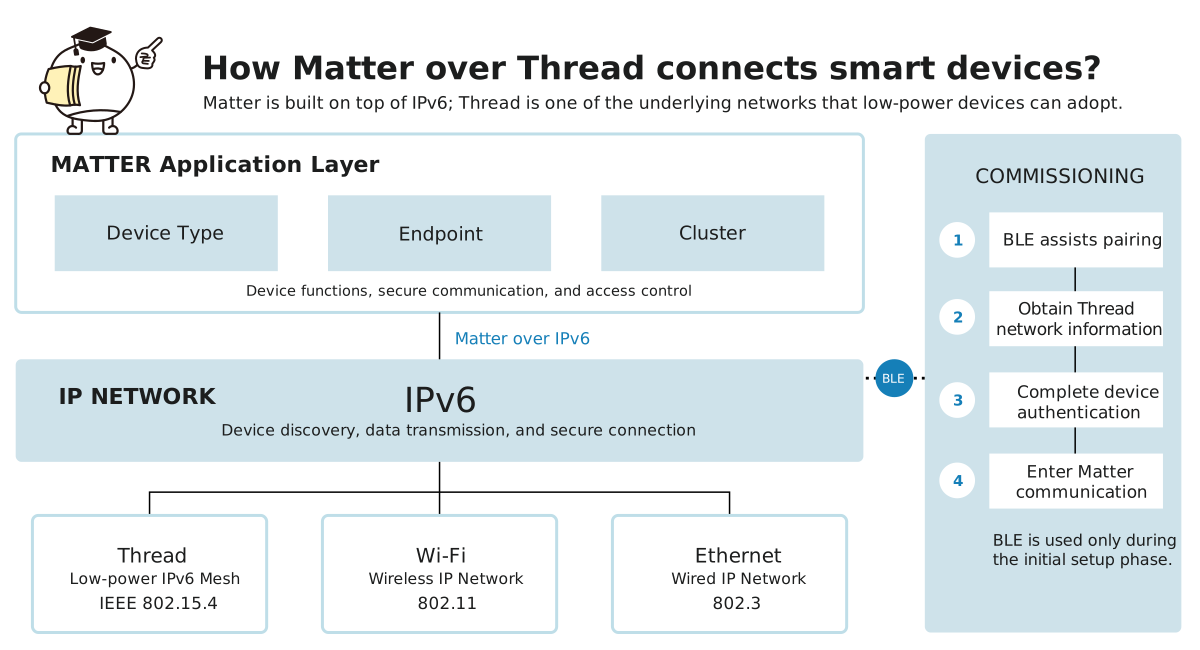
Thread is a low-power IPv6 Mesh network for battery devices, low-to-moderate data, and multi-node deployments. With Matter, it connects to Wi-Fi / Ethernet through a Thread Border Router.
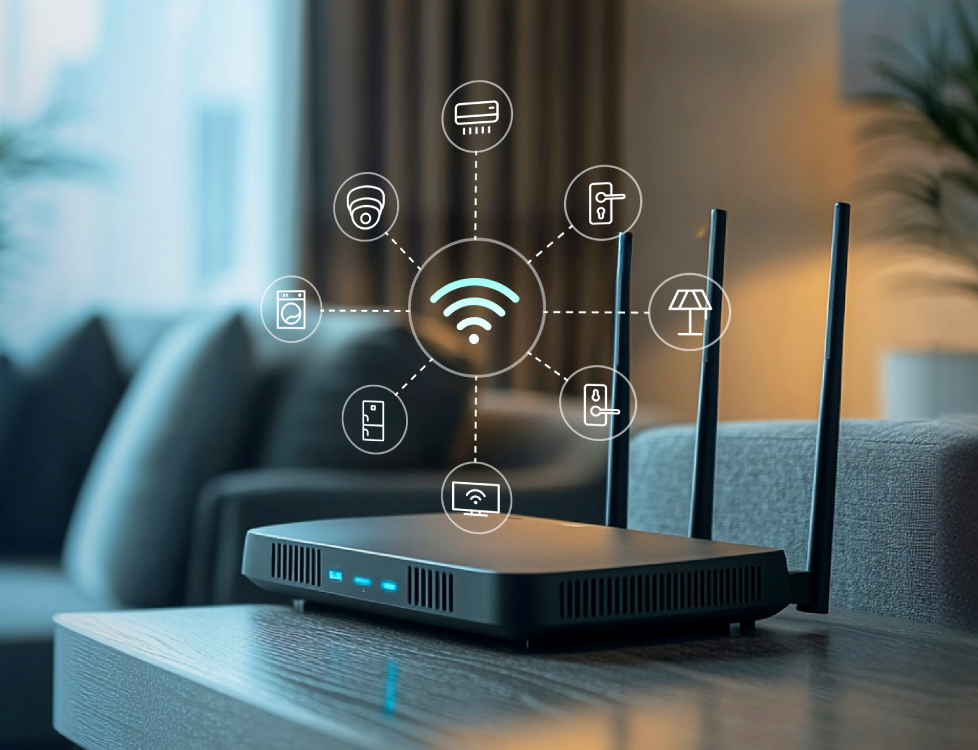
Matter defines device functions and interoperability; Thread provides low-power IPv6 connectivity. BLE assists Commissioning, then Thread handles daily communication.
Thread combines low power, Mesh networking, native IPv6, and multi-Border Router flexibility.
Built on IEEE 802.15.4 with sleepy-device support, ideal for battery sensors, locks, and buttons.

Router nodes extend the Thread network; Sleepy End Devices connect through a Parent Router.
Thread uses IPv6 directly, connecting to IP networks with fewer proprietary conversion layers.

A Thread network can use multiple Border Routers to improve path availability.
Power, data volume, and deployment are key factors when deciding whether Thread fits.
| Comparison | Thread | Wi-Fi |
|---|---|---|
| Network Architecture | IEEE 802.15.4 low-power IPv6 Mesh | Connects to a Wi-Fi Access Point |
| Power Characteristics | Suited to low-power and sleepy devices | Better suited to continuously powered devices |
| Data Transfer | Low-to-Moderate Data Volume | Higher bandwidth and larger data volumes |
| Network Role | Needs a Thread Border Router to reach other IP networks | Uses the existing Wi-Fi IP network |
Gateway, Hub, and controller products may combine several roles, with hardware/software duties varying by design.
Routes IPv6 packets between Thread and adjacent IP networks such as Wi-Fi or Ethernet.
For always-powered home hubs, Wi-Fi APs, and building controllers.Maps Zigbee, Z-Wave, Bluetooth Mesh, or proprietary devices to Matter device types and Clusters.
For upgrading existing ecosystems and extending legacy devices.Provides Thread radio and lower-layer networking over USB or UART; higher-layer Thread / Matter runs on the Host.
For adding Thread to existing hosts, Gateways, STBs, or controllers.Can combine Border Router, Matter Controller, Bridge, cloud, and UI functions.
For home or building platforms combining network, control, and management functions.New products, existing hosts, and Gateways need different approaches. Choose based on the MCU, Host architecture, and product role to limit board changes and software overlap.
Ciot helps plan Matter / Thread architecture across modules, firmware, security data, and production. Realtek is the primary platform; existing MCU, Module, or Host designs can also be assessed for RCP, product upgrades, and Border Router / Gateway hardware-software split.
Assess Realtek Matter / Thread modules and define End Device, Router, RCP, Border Router, and Host configuration.
Integrate Matter SDK, device types, Clusters, Host Command, GPIO, UART, I²C, and SPI.
Plan DAC / PAI, Factory Data, keys, TrustZone / Secure Element, then connect MES, programming tools, Provisioning, and Matter Certification.
No. Matter can use Thread, Wi-Fi, or Ethernet; choose based on power, bandwidth, power source, and deployment.
A Thread Border Router is needed when Thread must connect to adjacent IP networks such as Wi-Fi or Ethernet.
Border Router routes IPv6 between Thread and other IP networks; Matter Bridge maps non-Matter device functions into Matter devices and Clusters.
No. Routers forward traffic; Sleepy End Devices connect through a Parent Router and do not forward other nodes’ packets.
Yes, subject to evaluation. RCP provides Thread radio and lower-layer processing over USB or UART; the Host runs higher-layer software. Check performance, memory, and interface split.
No. A certified module does not automatically certify the end product; requirements still depend on module status, software version, product, market, and scope.
START WITH YOUR PRODUCT
Share product type, MCU / Module, power, connectivity, target market, and production timing. Ciot can assess End Device, RCP, Border Router, or hybrid designs.